
Curriculum and logbook
The syllabus, the grade sheet, and the logbook in one record
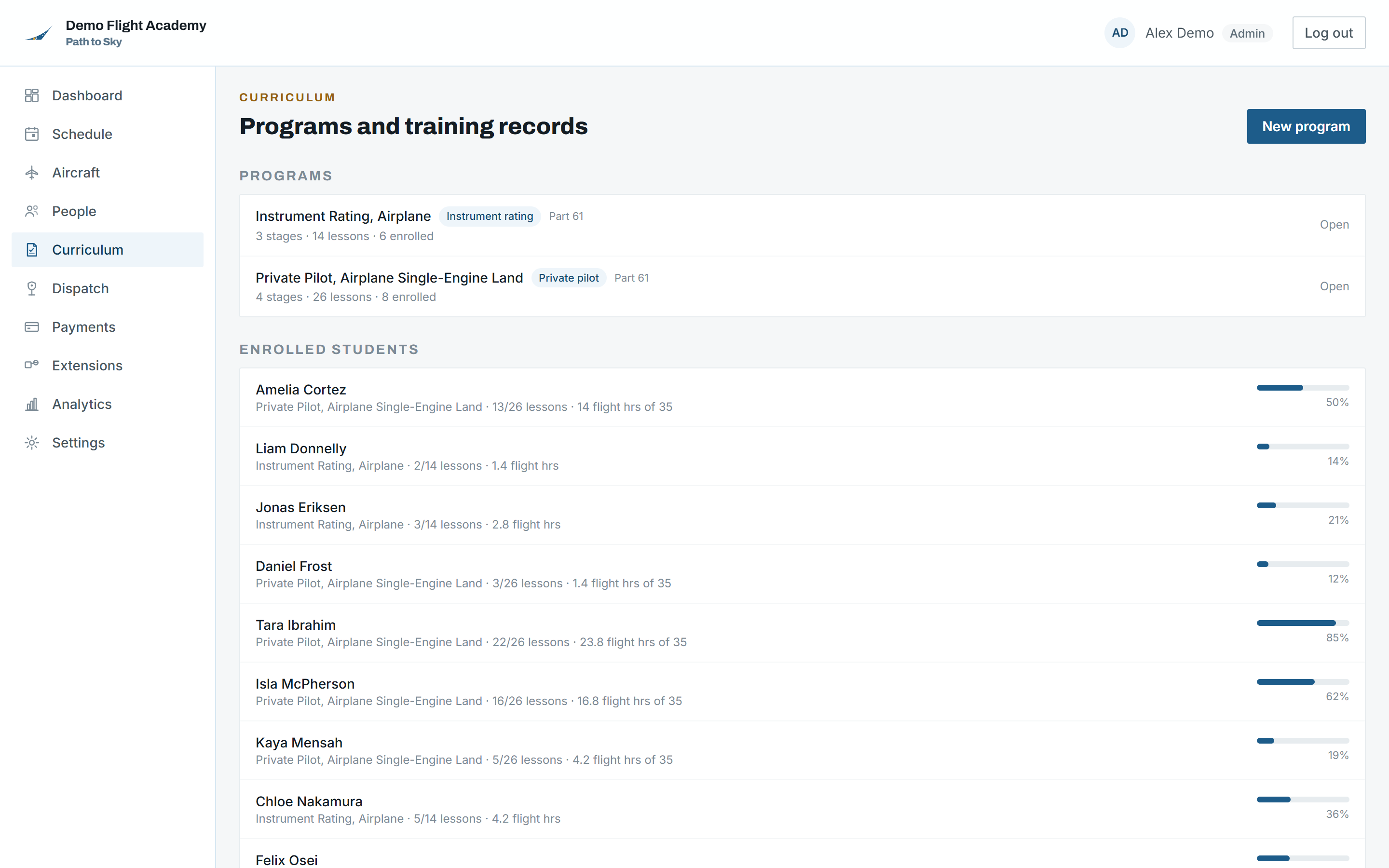
Build the program for each certificate you train toward, put students on it, and let the hours accrue from what was actually flown. Available as a $25 a month add-on on any plan.
Used by: Chief instructors, CFIs, and the students themselves
Curriculum and training records is an add-on: $25 a month for your operation, on top of your per-aircraft price. An admin can switch it on from inside the app.
What it does
Every line below is something in the product today, not on a roadmap.
Programs by certificate
- Start a program from the certificate it trains toward: private, instrument, commercial single and multi, the multi add-on, CFI, CFII, MEI, flight review, IPC, or the tailwheel, high performance, and complex endorsements.
- A starting program arrives with its stage and lesson outline and its Part 61 experience requirements already filled in, and every number is editable.
- A blank custom program for anything else you run, from a mountain checkout to a scenic-flight standardization course.
- Lessons carry an objective, completion standards, estimated ground and flight hours, and a kind: ground, flight, sim, or stage check.
- Graded tasks under each lesson, on the introduced, practiced, proficient, unsatisfactory scale.
- Stage checks can be required to come from an instructor who did not teach the stage. Required under Part 141; under Part 61 it is a per-program switch, because a single-instructor school could never satisfy it.
Students on a program
- Put a student on a program from their own record on the People page. A student can hold more than one at a time, which is how commercial and CFI actually overlap.
- A training record per student: every stage, every lesson, what has been flown, by whom, on what date, with the instructor's notes.
- Signing off a lesson records the result, the hours, and a grade per task, all in one transaction, so a record can never exist with half its grades.
- Experience requirements are measured from the logbook, not typed in, so an hour flown outside the syllabus still counts toward the certificate.
- Students open their own record and see where they stand without asking the front desk.
The logbook
- When the airplane comes back, the check-in is followed by the entry the instructor would write anyway, prefilled with the aircraft, the route, and the Hobbs time.
- The columns 61.51(b) asks for: date, total time, from and to, aircraft type and identification, and whether the time was solo, PIC, SIC, dual received, or instruction given.
- Conditions split the way they need to be: day, night, actual instrument, and simulated instrument as separate columns.
- Takeoffs and landings by day and night, full stops, and the location and type of each instrument approach with holding and course tracking, which is what 61.57 recency is counted from.
- Currency is computed from those columns and reported as dated facts, never as a verdict that you are legal to fly.
- Entries that cannot be true are refused: more PIC than the flight lasted, instrument time longer than the flight, a flight logged as both solo and dual received.
What it does not do. A school logbook is not a substitute for the pilot's own logbook, and currency counted here only sees flying recorded at this school. Both are stated plainly in the product, not buried.
See it against your own fleet
Bring your aircraft, your roles, and your current mess of spreadsheets. We'll walk through exactly how this maps to how you run today.